In Response (Again) To Cathy Inego On Mormonism

By Bro. Nathan
So again, ay agagwa ako ng isang article in response sa isang faulty interpretation ni Cathy Inegeo sa The Church Of Jesus Christ Of Latter Day Saints. ang post na ito with the same author ay same lang din sa previous na post niya na may mababaw na arguments at walang reasoning, so i decided na gawan pa ito ng article. (the content in the op will be marked in red.)
" Ayon kay Joseph Smith, sa isang pagkakataon ng kanyang buhay ay nagpakita sa kanya ang isang anghel na may pangalang Moroni at ipinagkaloob sa kanya ang isang gintong plaka na nakasulat ang walang hanggang ebanghelyo. Dagdag pa nila, ito daw ay sinulat ng isang propeta noong 420 AD na nagngangalang Mormon. At nang maisalin niya ito sa kanilang sariling wika ay ibinalik at kinuha uli ito ng anghel."
First, hindi ito plaka pero ito ay mga "lamina" at hindi plaka if marunong ka talaga magtranslate from english to tagalog. ang "lamina" ay isang record na out of metal sheets. ang plates ng Book Of Mormon ay described as gawa sa ginto. nasusulat ito sa pamamagitan ng pagukit (engraving). ang form ng writings na ganito ay mas well preserved comapared sa ibang forms ng writings kaya sa ganitong form naisulat ang Book Og Mormon. we have archeological evidences ng form ng writing na ito in the acient times gaya ng mga Babylonians, Mesoamericans, at maging sa Pilipinas.

King Darius Plates


Fr. Crespi and the Mesoamerican Mettalic Library in Ecuador

Laguna copperplate
And second, ang Book Of Mormon ay hindi isinulat ni Mormon but siya ang nagcompile at nagabridge. guilty sa strawman arguments ang author.
" Hindi sa paninirang puri, ang orihinal na doktrina ng samahang ito ay PINAPAYAGAN ANG PAG-AASAWA NG MARAMI o yung tinatawag na POLYGAMY. Ito'y ayon na rin sa kanilang opisyal na aklat na may titulong THE DOCTRINE AND COVENANTS, section 132: 4,6,19,26,27,41 at 42.
--Ang kanilang tagapagtatag na si Joseph Smith ay nagkaroon ng 28 asawa. At dahil sa polygamy naging laganap ang awayan ng mga pamilya at siya ay pinatay sa Carthage-3 noong 1884. Matapos ang kanyang malagim na kamatayan ay humalili sa kanya si Brigham Young- na matakaw din sa babae. Nagkaroon ng 27 asawa, 57 anak at 4000 na mga apo.
--Hindi naglaon, nabahala ang estado ng Amerika sa umiiral na Poligamiya sa relihiyong ito. Ipinatigil ng 1887 Congress of America at Federal Authorities ang ganitong gawain. At ganap lamang itong nahinto noong 1890."
We see sa starting point ng statement ang pagiinsert ng "hindi sa paninirang puri" para daw magmukhang legitimate at credible (even though it isn't) Ang polygamy too ay allowed sa Judaism. consider the following list of polygamist in the Bible and let us know why ba jinstify ng Dios ang polygamy ang even gave wives (2 Sam. 12:7). :
Abdon (Jdg. 12:14)
Abijah (2 Chr. 13:1)
Abraham (Gen. 16:1-3; 25:1)
Caleb (1 Chr. 2:18-19, 46-48)
David (1 Sam. 18:27; 19:11-18; 25:39-44; 2 Sam. 3:3-14; 5:13; 6:20-23; 12:7-24; 16:21-23)
Eliphaz (Gen. 36:11-12)
Elkanah (1 Sam. 1:2)
Esau (Gen. 26:34; 28:9)
Ezra (1 Chr. 4:17-18)
Gideon (Jdg. 8:30)
Heman (1 Chr. 25:4)
Hoseah (Hos. 1:3; 3:1)
Issachar (1 Chr. 7:4; cf. Num. 1:29)
Jacob/Israel (Gen. 29:23-28; 30:4-9)
Jehoiachin (2 Kgs. 24:15)
Jerahmeel (1 Chr. 2:26)
Jehoiada (2 Chr. 24:3)
Machir (1 Chr. 7:15-16)
Manasseh (1 Chr. 7:14)
Mered (1 Chr. 4:17-19)
Moses (Ex. 2:21; 18:1-6; Num. 12:1)
Nahor (Gen. 22:20-24)
Saul (1 Sam. 14:50; 2 Sam. 3:7)
Shaharaim (2 Chr. 8:8)
Simeon (Gen. 46:10; Ex. 6:15)
Solomon (1 Kgs. 11:3)
Zedekiah (Jer. 38:23)
At kung mapapansin antin, unsure yung writer kung tama nga ba yung sinasabi niya about sa number of wives ni Joseph Smith. others say na 40 daw, others say 38, and this one says 28. ano ba talaga? and yung source ay medyo suspicious. from official documents ba from the church at sa goverment ang source or from sa ulo lang niya at sa anti-mormon websites?
Ang writer ay guilty din sa Pos hoc, which is a logical fallacy. Joseph Smith was not murdered dahil sa polygamy ni nagaway man lang dahil sa polygamy. Emma Smith is totally okay sa polygamy based sa goverment records at mga interviews at Joseph Smith was murdered because of persecution. and yung number ng grandchildren ni Brigham Young ay exagrrated, thus guily sa strawman yung writer. at ang polygamy ay natigil hindi sa dahil sa laganap na practice ito but if nagbabasa ka talaga ng documents at ng church history, ito ay kusang itinigil para ang Utah ay magiging isang official na state ng U.S.A. from this we can see na ang invented na statements can be fallacious gaya nito na guilty sa pos hoc at strawman.
Here's what we can read from Official Declaration 1 or yung Manifesto :
To Whom It May Concern:
Press dispatches having been sent for political purposes, from Salt Lake City, which have been widely published, to the effect that the Utah Commission, in their recent report to the Secretary of the Interior, allege that plural marriages are still being solemnized and that forty or more such marriages have been contracted in Utah since last June or during the past year, also that in public discourses the leaders of the Church have taught, encouraged and urged the continuance of the practice of polygamy—
I, therefore, as President of The Church of Jesus Christ of Latter-day Saints, do hereby, in the most solemn manner, declare that these charges are false. We are not teaching polygamy or plural marriage, nor permitting any person to enter into its practice, and I deny that either forty or any other number of plural marriages have during that period been solemnized in our Temples or in any other place in the Territory.
One case has been reported, in which the parties allege that the marriage was performed in the Endowment House, in Salt Lake City, in the Spring of 1889, but I have not been able to learn who performed the ceremony; whatever was done in this matter was without my knowledge. In consequence of this alleged occurrence the Endowment House was, by my instructions, taken down without delay.
Inasmuch as laws have been enacted by Congress forbidding plural marriages, which laws have been pronounced constitutional by the court of last resort, I hereby declare my intention to submit to those laws, and to use my influence with the members of the Church over which I preside to have them do likewise.
There is nothing in my teachings to the Church or in those of my associates, during the time specified, which can be reasonably construed to inculcate or encourage polygamy; and when any Elder of the Church has used language which appeared to convey any such teaching, he has been promptly reproved. And I now publicly declare that my advice to the Latter-day Saints is to refrain from contracting any marriage forbidden by the law of the land.
Wilford Woodruff
President of The Church of Jesus Christ of Latter-day Saints.
President Lorenzo Snow offered the following:
“I move that, recognizing Wilford Woodruff as the President of The Church of Jesus Christ of Latter-day Saints, and the only man on the earth at the present time who holds the keys of the sealing ordinances, we consider him fully authorized by virtue of his position to issue the Manifesto which has been read in our hearing, and which is dated September 24th, 1890, and that as a Church in General Conference assembled, we accept his declaration concerning plural marriages as authoritative and binding.”
Salt Lake City, Utah, October 6, 1890.
EXCERPTS FROM THREE ADDRESSES BY
PRESIDENT WILFORD WOODRUFF
REGARDING THE MANIFESTO
The Lord will never permit me or any other man who stands as President of this Church to lead you astray. It is not in the programme. It is not in the mind of God. If I were to attempt that, the Lord would remove me out of my place, and so He will any other man who attempts to lead the children of men astray from the oracles of God and from their duty. (Sixty-first Semiannual General Conference of the Church, Monday, October 6, 1890, Salt Lake City, Utah. Reported in Deseret Evening News, October 11, 1890, p. 2.)
It matters not who lives or who dies, or who is called to lead this Church, they have got to lead it by the inspiration of Almighty God. If they do not do it that way, they cannot do it at all. …
I have had some revelations of late, and very important ones to me, and I will tell you what the Lord has said to me. Let me bring your minds to what is termed the manifesto. …
The Lord has told me to ask the Latter-day Saints a question, and He also told me that if they would listen to what I said to them and answer the question put to them, by the Spirit and power of God, they would all answer alike, and they would all believe alike with regard to this matter.
The question is this: Which is the wisest course for the Latter-day Saints to pursue—to continue to attempt to practice plural marriage, with the laws of the nation against it and the opposition of sixty millions of people, and at the cost of the confiscation and loss of all the Temples, and the stopping of all the ordinances therein, both for the living and the dead, and the imprisonment of the First Presidency and Twelve and the heads of families in the Church, and the confiscation of personal property of the people (all of which of themselves would stop the practice); or, after doing and suffering what we have through our adherence to this principle to cease the practice and submit to the law, and through doing so leave the Prophets, Apostles and fathers at home, so that they can instruct the people and attend to the duties of the Church, and also leave the Temples in the hands of the Saints, so that they can attend to the ordinances of the Gospel, both for the living and the dead?
The Lord showed me by vision and revelation exactly what would take place if we did not stop this practice. If we had not stopped it, you would have had no use for … any of the men in this temple at Logan; for all ordinances would be stopped throughout the land of Zion. Confusion would reign throughout Israel, and many men would be made prisoners. This trouble would have come upon the whole Church, and we should have been compelled to stop the practice. Now, the question is, whether it should be stopped in this manner, or in the way the Lord has manifested to us, and leave our Prophets and Apostles and fathers free men, and the temples in the hands of the people, so that the dead may be redeemed. A large number has already been delivered from the prison house in the spirit world by this people, and shall the work go on or stop? This is the question I lay before the Latter-day Saints. You have to judge for yourselves. I want you to answer it for yourselves. I shall not answer it; but I say to you that that is exactly the condition we as a people would have been in had we not taken the course we have.
… I saw exactly what would come to pass if there was not something done. I have had this spirit upon me for a long time. But I want to say this: I should have let all the temples go out of our hands; I should have gone to prison myself, and let every other man go there, had not the God of heaven commanded me to do what I did do; and when the hour came that I was commanded to do that, it was all clear to me. I went before the Lord, and I wrote what the Lord told me to write. …
I leave this with you, for you to contemplate and consider. The Lord is at work with us. (Cache Stake Conference, Logan, Utah, Sunday, November 1, 1891. Reported in Deseret Weekly, November 14, 1891.)
Now I will tell you what was manifested to me and what the Son of God performed in this thing. … All these things would have come to pass, as God Almighty lives, had not that Manifesto been given. Therefore, the Son of God felt disposed to have that thing presented to the Church and to the world for purposes in his own mind. The Lord had decreed the establishment of Zion. He had decreed the finishing of this temple. He had decreed that the salvation of the living and the dead should be given in these valleys of the mountains. And Almighty God decreed that the Devil should not thwart it. If you can understand that, that is a key to it. (From a discourse at the sixth session of the dedication of the Salt Lake Temple, April 1893. Typescript of Dedicatory Services, Archives, Church Historical Department, Salt Lake City, Utah.)
Another example ng strawman fallacy. the real thing based sa theories ng mga church autorithies,is that God the Father is an exalted being and not a normal human like you and me. and the statement ng writer is another example ng appealing to ignorance. If nasaan sa Bible yung doctrine na may wife ang God the Father, alamin muna kung ano ba ang ibig sabihin ng greek word na γένος sa Acts 17:29 (cf. Jn. 20:17-18; Heb. 12:9)
" --Maging sa kanilang BOOK OF MORMONS makikita ang maraming pagkakamali ng isang matalinong nagsusuri. Isang halimbawa sa marami nilang maling aral ; Sa nabanggit na aklat ay mababasa na si Cristo ay ipinanganak sa Jerusalem. Ito po'y mali, sapagkat si Cristo ayon sa Bible ay isinilang sa Bethlehem. Ang Bethlehem ay hindi sakop ng Jerusalem !!! Milya-milya ang layo nito sa Jerusalem."
Another example ng ignorante sa literary context at historical context. if babasahin ng mabuti yung context ng Alma 7, ang nakalagay ay "land of Jerusalem" at hindi "city of Jerusalem". and take note, ang "Land of Jerusalem" sa bible was used para irepresent ang buong Southern Kingdom (Judea).
One Latter Day Saint wrote :
" One of the most popular anti-Mormon claims is that the Book of Mormon gives the wrong location for the birth of Jesus Christ. "The Book of Mormon teaches that Jesus Christ was born at Jerusalem (Alma 7:10)," says one representative anti-Mormon volume. "Of course, the Bible teaches He was born at Bethlehem (Matthew 2:1)." However, since Bethlehem is five or six miles from Jerusalem, and is a distinct town, the critics claim that "Alma 7:10 is clearly a false prophecy."
It is sometimes rather difficult to see the point of this hoary old anti-Mormon chestnut. 2 After all, no Latter-day Saint has ever interpreted the Book of Mormon as claiming that Jesus was born in Jerusalem rather than in Bethlehem. Alma 7:10 does not even mention the city of Jerusalem. Rather, the text reads: "And behold, he [Jesus] shall be born of Mary, at Jerusalem which is the land of our forefathers." The Jerusalem at which Jesus was to be born is thus quite clearly called a land, not a city. As we shall demonstrate below, this is quite consistent with both biblical and Near Eastern literary practice. Latter-day Saints are quite content to believe both Alma and the New Testament, and to see them in harmony. Happily, the evidence is overwhelmingly on our side.
General Considerations
Relativity of geographical designators. From across the ocean, the distance between Jerusalem and Bethlehem would hardly have seemed significant to a Nephite. We routinely speak, in the United States, of people who live in "the Chicago area" or in "the vicinity of Boston." When in the Middle East or Europe (or often even in Utah), one of the authors routinely answers "Los Angeles" when asked where he is originally from, although that answer is literally untrue, and the more accurate reply would be "Pasadena" (birthplace), or "San Gabriel" (residence through high school), or even "Whittier" (residence of his parents since the mid-1970s).
More to the point, the other author was temporarily assigned to duty at the BYU Jerusalem Center for Near Eastern Studies. If, upon his return to the U.S., he were to state, "I lived for six months in Ramat Eshkol," how many people would know the place to which he referred? Very few. On the other hand, if he were to say, "I lived six months in Jerusalem," everyone would understand. But Ramat Eshkol is a suburb of Jerusalem, several miles to the north, and technically not part of the city itself. Thus, to those familiar with the microgeography of Jerusalem and Israel, Ramat Eshkol would be a meaningful geographical designator. To those only vaguely familiar with Israel, however, Jerusalem would be much more meaningful. Therefore, since those ignorant of Jerusalem's microgeography significantly outnumber those who know it (especially in North America), he usually says that he lived in Jerusalem. Does this somehow make him a liar? Or, more drastically, are we to assume—paralleling the methods of the critics—that, because he says he lived in Jerusalem instead of Ramat Eshkol, he never lived in Israel at all, and, indeed, that he doesn't even exist?
All this may help us understand why Alma did not give a more precise location for the birth of Jesus. It is probably because he was talking to people some five centuries removed from any direct knowledge of the geography of Judea. Bethlehem is never mentioned in the Book of Mormon, and its exact location would almost certainly have been unknown to the average nonscholarly Nephite. Furthermore, copies of the scriptures are unlikely to have been widely distributed among ordinary people since, without the printing press, they would simply have been too expensive. A prophetic reference to a small unfamiliar village near Jerusalem would, therefore, likely have been meaningless to Alma's audience. Jerusalem, by contrast, was well known and frequently mentioned.
The "idiot-savant" paradox. Furthermore, to suggest that Joseph Smith knew the precise location of Jesus' baptism by John ("in Bethabara, beyond Jordan," 1 Nephi 10:9; cf. John 1:28), but hadn't a clue about the famous town of Christ's birth, is inconsistent.4 It is highly improbable that the Book of Mormon's author or authors missed one of the most obvious facts about the most popular story in the Bible—something known to every child and to every singer of Christmas carols?5 Do they intend to say that a clever fraud who could write a book displaying so wide an array of subtle and authentic Near Eastern and biblical cultural and literary traits as the Book of Mormon does was nonetheless so stupid as to claim, before a Bible-reading public, that Jesus was born in the city of Jerusalem? As one anti-Mormon author has pointed out, "every schoolboy and schoolgirl knows Christ was born in Bethlehem."6 Exactly! It is virtually certain, therefore, that Alma 7:10 was as foreign to Joseph Smith's preconceptions as it is to those of anti-Mormon critics. He is hardly likely to have twisted the Christmas story in so obvious a way, to have raised so noticeable a red flag, if he were trying to perpetrate a deception.
However, the Book of Mormon's prophecy that Christ would be born "at Jerusalem which is the land of our fathers" fits remarkably well with what we now know to have been ancient usage.7 Far from casting doubt upon the authenticity of the book, the statement in Alma 7:10 represents a striking bull's-eye.
Ang Mga Geographical Terminologies sa
Book Of Mormon
First, para maintindihan natin kung bakit nga ba ginamit yung phrase na yun sa Book Of Mormon, we must first tingnan yung context, both literary at historical.
The phrase "land of [city-name]" in the Book of Mormon. It emerges from an examination of the data that the Book of Mormon routinely refers to "lands" that both surround and bear the names of their chief cities. We read, for instance, of the lands and cities of Ammonihah, Gideon, Helam, Jashon, Lehi, Lehi-Nephi, Manti, Morianton, Moroni, Mulek, Nehor, Nephihah, Noah, Shem, and Shilom.8 The cities and lands of Bountiful and Desolation play a central role in Nephite history. So, too, do the city and land of Nephi.Thus, Amalickiah "marched with his armies . . . to the land of Nephi, to the city of Nephi, which was the chief city" (Alma 47:20). Notice, incidentally, that Alma had to specify that his prophecy in Alma 7:10 referred to "Jerusalem which is the land of our forefathers," since the Old World city and land were mirrored in a New World land and city of Jerusalem (Alma 21:1—2; 24:1) that were much more directly familiar to his audience.
Far and away the most important example of the situation under discussion here is Zarahemla. Indeed, it was probably the most important of all Nephite cities (Alma 60:1). But it is also the name of a land.Thus, the king of the rebels against Pahoran entered into an alliance with the Lamanites "to maintain the city of Zarahemla, which maintenance he supposeth will enable the Lamanites to conquer the remainder of the land" (Alma 61:8). And when Moroni and Pahoran counterattacked, they "went down with their armies into the land of Zarahemla, and went forth against the city" (Alma 62:7). Later, the Lamanites again came "into the center of the land" and took "the capital city which was the city of Zarahemla" (Hel. 1:27). Thus from the Book of Mormon perspective, every major city was surrounded by its land.
The phrase "land of Jerusalem" in the Book of Mormon. Several instances make it clear that Old World Jerusalem was regarded in precisely the same way by the Nephites as were their own cities and lands. Sometimes the phrase "land of Jerusalem" seems to have referred to the area immediately around the city, or perhaps to the region of Judea. Jesus told the Nephites, for example, of "other sheep, which are not of this land, neither of the land of Jerusalem, neither in any parts of that land round about whither I have been to minister" (3 Ne. 16:1). Lehi's party and the Mulekites are said to have departed from "the land of Jerusalem."12 And Lehi dwelt "at Jerusalem" (1 Ne. 1:4, 7), but evidently outside the city proper (1 Ne. 3:16, 23—24). On other occasions, by contrast, the phrase seems to denote Judea and Galilee and perhaps all of Palestine. Thus, the Nephites were informed that Christ would "show himself" in "the land of Jerusalem" (Hel. 16:19). Thus, too, the Book of Mormon says that Christ chose his disciples in "the land of Jerusalem" (Morm. 3:18—19)—although the New Testament specifies that at least several of the apostles were called in Galilee. In Nephite usage, "the land of Jerusalem" is the land of the Jews' eschatological inheritance, or at least the area to which they would return following their Babylonian exile. Thus, the phrase clearly refers to an area considerably larger than the urban area of Jerusalem proper
What do we learn from the use of this phrase during the biblical period? Anti- Mormons claim, correctly, that the precise phrase "land of Jerusalem" never occurs in the Bible. However, this is almost certainly not as important a fact as they believe it to be.
Jerusalem played a central administrative and political role from the reign of King David in the tenth century B.C. down to the period of the Babylonian exile—i.e., to roughly, hanggang sa time ng departure ni Lehi at ng mga Mulekites. King Solomon divided his kingdom into 12 districts, largely para sa purposes of taxation, with each one governed from an administrative center. One of those districts included both Bethlehem and Jerusalem, with the latter serving as district capital. During the reign of Hezekiah, between 716 and 687 B.C., Solomon's twelve districts were consolidated into four, with Jerusalem doing "double duty as the royal and district capital." (Aharoni, The Archaeology of the Land of Israel, 259.)"

Lehi's contemporary, the prophet Jeremiah, describing the siege of Jerusalem, says that Nebuchadnezzar's armies fought "against Jerusalem and all its surrounding towns" (Jer. 34:1 NIV) by which na maaring nagrerefer siya sa ibang mga cities (Jer. 34:7). In this, Jeremiah was entirely consistent with common biblical usage, according to which ang pangalang Jerusalem ay kadalasang ginagamit para itukoy ang buong soutern Kingdom, Judea (2 Kgs. 21:13; Is. 10:10—11; Ezek. 23:4; Micah 1:1, 5). Ang iba pang mga lungsod, mayroon ding mga nakapalibot na lupain, that was entitled in the same way.let us take for example, ang Samaria ay madalas na ginagamit to represnet the northern Kingdom (Israel),even though isa lang itong name ng city na tinatag ni King Omri noong 9 B.C. (1 Kgs.16:24). makikita natin sa Bible na may "cities of Samaria." (1 Kgs. 13: 13; 2 Kgs. 17: 23, 26; 23:19; Ez. 4:16). Sa gayon, kapag nabasa natin ang about kay "Achab, the King of Samaria" and we should understant na nirurule niya ng monarchy ng Nothern Kingdom as a whole, at hindi lang ng main city. Sinasabi din ng Jeremiah 31: 5 na "mountains of Samaria."
Similarly, pagmamayari ng Ephraim ang city of "Tappuah," pero nakuha din ng Manasseh ang teritory (Johs. 17:8)—which the Interpreter's Dictionary of the Bible quite correctly terms "the land of Tappuah."(George Arthur Buttrick, ed., The Interpreter's Dictionary of the Bible [hereafter IDB], 4 vols. and supplement (Nashville: Abingdon, 1962—1976), 4:517; cf. Paul J. Achtemeier, ed., Harper's Bible Dictionary [hereafter HBD] (San Francisco: Harper and Row, 1985), 1017.) The town of "Tob" was surrounded, biblically, by "the land of Tob" (Jdg. 11:3). There was a city Mizpah (or Mizpeh) as well as the "land of Mizpah" (Josh. 11:3).
Ang isang Syrian city sa Damascus ay tila nagmamay-ari ng isang "ilang" (1 Kgs. 19:15). Gayundin, ang Canaanite city ng Hazor ay tila napapaligiran ng isang lupain in the same name (Kitchen, Ancient Orient and Old Testament, 68.) Sa Arabia, is both land and city (Isa. 21:14), tulad ng, tila, ay "Ur of the Chaldees." sa panahon ni Lehi, ginamit ni Jeremiah ang "land of Babylon" (Jer. 50:28; 51:29), in the same way ay ginamit para sa pinagmulan ng land ng Babylon. At nang si Abraham ay "nanirahan sa Gerar" (Gen. 20: 1),one scholar said na "malinaw na sa teritoryo na napangalan, hindi ang pader na lunsod mismo."
Ang Sodom at Gomorra, ang "mga lungsod ng kapatagan" and the Savior might refer sa "land of Sodom and Gomorra" (Mt. 10:15; cf. 11:24). Ang Hamath ay isang valued na bayan sa river ng Orontes sa Syria. Si Riblah ay isang sinaunang bayan ng Syrian din. Gayunpaman, sa maraming mga punto sa Hebrew Bible nabasa natin ang "Riblah sa lupain ng Hamath" - iyon ay, isang lungsod na nasa "lupain ng" ibang lungsod. (2 Kgs. 23:33; 25:21; Jer. 39: 5; 52: 9, 27) Ang paggamit na ito ay tiyak na tumutugma sa mga pagtatalo ng mga Huling Araw na ang lungsod ng Bethlehem ay maaaring inilarawan sa terminolohiya ng salitang Hebreo na nasa "lupain ng" Jerusalem.in fact meron tayong parallel na "lupain ng kanilang mga lungsod" (Heb. eretz sha'aray-u) in the context ng 1 Kgs. 8:37, implies na sa Hebrew, ay ginagamit ito bilang isang generic grammatical form. ang Hebrew ng passage is read as follows :
רעב כי־יהיה בארץ דבר כי־יהיה שׁדפון ירקון ארבה חסיל כי יהיה כי יצר־לו איבו בארץ שׁעריו כל־נגע כל־מחלה׃ (1 Kgs. 8:37)
Thus, although the specific phrase "land of Jerusalem" is not itself found in the Bible, it is perfectly acceptable biblical usage for the region around a major city, including smaller towns, to be referred to as "the land of" that city.
The city-state Jerusalem and its "land" in the early sixth century B.C. At the time of the beginning of Book of Mormon history (597 B.C.), Jerusalem could best be considered as nothing more than a city-state. The former kingdom of Judah had been completely conquered by the Babylonians on 16 March 597 B.C., after which time Zedekiah (Mattaniah) was placed on the throne as a Babylonian puppet. Thus, the "first year of the reign of Zedekiah, king of Judah" (1 Ne. 1:4), when the story of Lehi opens, was precisely the year of the collapse of the kingdom of Judah, and its reduction to a vassal city state under Babylonian domination. Although technically still called the "kingdom of Judah," the area of Zedekiah's rule had in fact been reduced to the region directly surrounding Jerusalem, which could well be called the "land of Jerusalem." As John Bright describes it, "Certain of [Judah's] chief cities, such as Lachish and Debir, had been taken by storm and severely damaged. Her territory was probably restricted by the removal of the Negeb from her control, her economy crippled and her population drastically reduced."Contemporary Babylonian texts describe Jerusalem as "the city" of Judah: "In the month of Kislimu, the King of Akkad called up his army, marched against the city of Judah [Jerusalem] and seized the town." Assyrian provincial terminology generally used the name of the capital of a province to designate that province as a whole, and such usage appears to have continued among the Babylonians. This practice would have therefore been familiar to Lehi.
Ang naming ng isang lupain or teritorry after sa leading city or capital nito ay present sa Near East.
Jeff Lindsay gives historical and literary evidence for these statements including yung isang discovered na record, the dead sea scrolls at ang Amarna letter which uses the same phrase na "the land of Jerusalem :
Revisiting the Land of Jerusalem
via the Dead Sea Scrolls
For over 160 years, beginning at least with the 1833 publication of Alexander Campbell's Delusions, countless critics have claimed that the Book of Mormon's use of the phrase "land of Jerusalem" was a major error and proof that the Book of Mormon was false. They especially criticized the use of this phrase in reference to the place where Christ would be born. That phrase was not used in the Bible nor in the Apocrypha. Therefore, the critics concluded, it was an example of Joseph Smith's ignorance and evidence that he had tried to perpetrate a fraud. (For a thorough overview of this argument, see the essay by Daniel Peterson in Review of Books on the Book of Mormon, 5:62-78.)
For anyone honestly concerned with the authenticity of the Book of Mormon, there was little to argue about after Hugh Nibley showed in 1957 that one of the Amarna letters, written in the 13th century B.C. and discovered in 1887, recounted the capture of "a city of the land of Jerusalem, Bet-Ninib" (CWHN 6:101 [Note from J.L.: CWHN = The Collected Works of Hugh Nibley. Volume 6 is An Approach to the Book of Mormon]). Predictably, this evidence, along with further evidence of the general usage of this type of terminology in the Old World (see John W. Welch, ed., Reexploring the Book of Mormon, 170-72) has been ignored by critics of the Book of Mormon.
Now from the Dead Sea Scrolls comes an even more specific occurrence of the phrase "land of Jerusalem" that gives insight into its usage and meaning - in a text that indirectly links the phrase to the Jerusalem of Lehi's time.
Robert Eisenmann and Michael Wise, in The Dead Sea Scrolls Uncovered (1993), discuss one document that they have provisionally named "Pseudo-Jeremiah" (scroll 4Q385). The beginning of the damaged text reads as follows:
...Jeremiah the Prophet before the Lord
[...w]ho were taken captive from the land of Jerusalem [Eretz Yerushalayim, column 1, line 2] (p. 58).
In their discussion of this text, Eisenmann and Wise elaborate on the significance of the phrase "land of Jerusalem," which they see as an equivalent for Judah (Yehud):
"Another interesting reference is to the 'land of Jerusalem' in Line 2 of Fragment 1. This greatly enhances the sense of historicity of the whole, since Judah or 'Yehud' (the name of the area on coins from the Persian period) by this time consisted of little more than Jerusalem and its immediate environs." (p. 57)
Based on the evidence from Qumran, and in the words of Eisenmann and Wise, we can conclude that consistent usage of such language among a people of Israel who fled Jerusalem at the time of Jeremiah also "greatly enhances the sense of historicity" of the Book of Mormon.
Critics of the Book of Mormon will not likely give up this argument, despite the evidence. This is not surprising, after all, because the part of their argument that the phrase was not known in Joseph Smith's day was correct. Virtually all opponents of the Book of Mormon have to assume, a priori, that the text is a purely human 19th-century document in order to justify their rejection of the text. In the case of "land of Jerusalem," since the phrase could not be explained as being part of Joseph's learning environment and since it was not known in biblical literature, they incorrectly concluded that Joseph must have been wrong. Trying to prove a negative, they argued from silence and puffed this supposed error into what they believed was one of their highest polemical mountains of evidence against the Book of Mormon.
The phrase was not current in Joseph's day, but, unknown to him, it was an accurate usage for the day in which he claimed the book was written. Thus, despite the critics' best efforts, Joseph's supposed "error" becomes one more evidence for the Book of Mormon's authenticity.
Based on research by Gordon C. Thomasson.
2010 Update: More from the
Amarna Letters
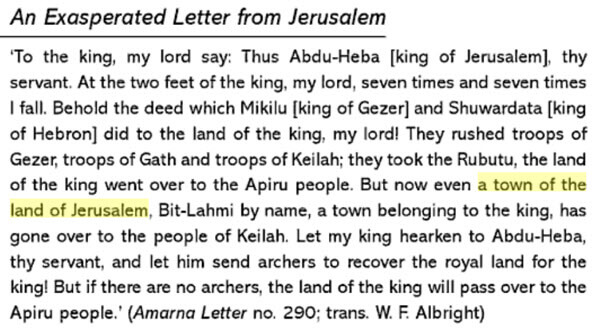
In addition to the passage Hugh Nibley noticed in the Amarna Papers, mentioned in the excerpt from FARMS given above, a more interesting passagee in the ancient Amrana Papers was recently pointed out to me by Ronnie Bray in the U.K. (see his his YorkshireTales.com site, especially the All About Mormonism section). You can see this in The Holy Land: an Oxford archaeological guide from earliest times to 1700 by Jerome Murphy-O'Connor, p. 290. This letter from Jerusalem declares that "now even a town of the land of Jerusalem, Bit-Lahmi by name, has gone over to the people of Keila." (Amarna Letter No. 290, translated by W.F. Albright). So there you have it: the land of Jerusalem included a rebellious little town known as Bit-Lahmi, as in Bethlehem. Bingo. This excerpt from Google Books is shown below:
Feb. 2001 Update:
More Evidence from the Dead Sea ScrollsTwo non-LDS scholars, Robert Eisenman and Michael Wise, discuss an example of the phrase "land of Jerusalem" in the Dead Sea Scrolls in a passage discussing the time of the prophet Jeremiah. They write that the use of this term "greatly enhances the sense of historicity of the whole, since Judah or 'Yehud' (the name of the area on coins from the Persian period) by this time consisted of little more than Jerusalem and its immediate environs" (The Dead Sea Scrolls Uncovered, New York: Barnes and Noble Books, 1992, p. 57, referring to a passage translated on p. 58). Jeremiah's time overlapped with Lehi's time, and in that time, what was latter called Judah or the land of Judah could appropriately be called "the land of Jerusalem," a term that "greatly enhances the sense of historicity of the whole" when used in a document linked to Jeremiah's time. Should not the same be said of the Book of Mormon?
Lehi and his people left "the land of Jerusalem" in Jeremiah's day. With the Dead Sea Scrolls before us, we now know it would be perfectly logical for them to refer to the place where Christ would be born as "the land of Jerusalem." Use of that term was utterly illogical for Joseph Smith, who published the Book of Mormon over a century before the Dead Sea Scrolls were even discovered.
Further notes from Jeff LindsayMy computer search of the Book of Mormon reveals 40 cases where the exact phrase "land of Jerusalem" occurs in reference to the Old World (there was also a Lamanite place in the New World named for Jerusalem), plus several other places where the Old World Jerusalem is referred to as a "land" (most notably, Alma 7:10). This usage is found in multiple books of the Book of Mormon, from Nephi in the 6th century B.C. (who used the phrase most frequently) to Mormon near 400 A.D.
The following verses use the phrase "land of Jerusalem":
1 Ne. 2:11; 3:9-10; 5:6; 7:2 - 7; 16:35; 17:14 - 22; 18:24; 2 Ne. 1:1-30; 25:11; Jac. 2:25-32; Omni 1:6; Mosiah 1:11; 2:4; 7:20; 10:12; Alma 3:11; 9:22; 10:3; 22:9; 36:29; Hel. 5:6; 7:7; 8:21; 16:19; 3 Ne. 1:2; 5:20; 16:1; 20:29; Morm. 3:18-19; Eth. 13:7
J.L.'s note: The "offending" passage is Alma 7:10, where the prophet Alma predicts the birth of Christ, saying,
"And behold, he shall be born of Mary, at Jerusalem which is the land of our forefathers, she being a virgin, a precious and chosen vessel..."In Alma's time, 500 years after Nephi arrived in the New World, details of the geography of Israel were long forgotten. We should not be surprised to see that the land of Jerusalem is referred to as the place of Christ's birth - an entirely accurate and useful description, given the meaning of the phrase - rather than the nearby village of Bethlehem, a virtual suburb of the city of Jerusalem, roughly 5 miles away.
On this point, critics have long argued that the Book of Mormon is false because "everybody knows that Christ was born in Bethlehem." Certainly Joseph Smith knew that - he was familiar with much of the Bible and had heard the story of Christ's birth numerous times. If he were making the Book of Mormon up, why on earth would he make such a terrible blunder, placing Christ's birth in Jerusalem? How could he make such a thoughtless and stupid blunder in the midst of an otherwise enormously clever fraud? The "blunder" makes no sense if Joseph Smith were the author - but it is not a blunder at all and makes perfect sense if he were only translating an authentic ancient document. The use of the term "land of Jerusalem" in Alma 7:10 and many other locations can now be viewed as powerful evidence for the authenticity of the Book of Mormon, based on recent discoveries about the use of that term in the ancient world. Joseph Smith could not possibly have made that up.
[top]
More information from John Tvedtnes:Here is an e-mail from John Tvedtnes sent to a group in Aug. 1999:
Since virtually everyone--children and adults--in Joseph Smith's day knew that Jesus was born in Bethlehem, how could the prophet possibly have erred? The name Jerusalem has to be deliberate. It is, in fact, significant that in this passage Alma did not claim that Jesus would be born in the city of Jerusalem, but "at Jerusalem which is the land of our forefathers." While it is not found in the Bible even once, the term "land of Jerusalem" occurs over 40 times in the Book of Mormon, while other passages also refer to Jerusalem as a "land" (Alma 7:10; 21:1; 3 Nephi 20:33, 46).
Lehi and Nephi seem to have known the designation of Jerusalem as both a city and the land it governed. The term "land of Jerusalem" is found in 1 Nephi 3:9-10; 7:2. In the Book of Mormon, we read that Lehi dwelt "at Jerusalem in all his days" (1 Ne. 1:4). But he clearly did not live in the city of Jerusalem. After coming to Jerusalem, where Laman visited Laban in his house (1 Ne. 3:11, 23), Lehi's sons, thinking to bribe Laban, "went down to the land of [their] inheritance" (1 Ne. 3:22) to gather up their wealth. They then "went up again" to Jerusalem (1 Ne. 3:23) and offered to buy the plates from Laban. He chased them away and, after a time, they returned to "the walls of Jerusalem" (1 Ne. 4:4), and Nephi "crept into the city and went forth towards the house of Laban." >From this, it is evident that the "Jerusalem" where Lehi lived had to be other than the city, and therefore somewhere nearby, in the "land of Jerusalem."
Throughout the Book of Mormon, the terms "city" and "land" seem to be interchangeable. There is a city of Nephi and a land of Nephi, a city of Zarahemla and a land of Zarahemla, and so forth. Evidently, each city controlled a certain territory or land that was denominated from the name of the city. This is especially clear in Alma 50:14, where we read of the construction of a new site: "They called the name of the city, or the land, Nephihah." The pattern followed by the Nephites (and by the Lamanites when they became sedentary) was evidently brought from the Old World. In ancient Israel, the "fenced" or walled cities were places of refuge for farmers in surrounding villages (Lev. 25:31; 1 Sam. 6:18; Ezek. 38:11. In time of war, the peasants could flee to the protection of the city walls, where arms were stored for defense. This is precisely what we find described in Mosiah 9:14-16.
Biblical cities, like those of the Book of Mormon, controlled nearby land. Hence, we read of "the king of Ai, and his people, and his city, and his land" (Josh. 8:1) and of the city of Hebron, its suburbs, fields and villages (1 Chr. 6:55-56). In the Bible, cities are sometimes called by the term "land." Tappuah is called a "land" in Joshua 17:8, but a "city" in Joshua 16:8. Jeremiah prophesied that Jerusalem would become "a land not inhabited" (Jer. 6:8; cf. 15:5-7). The Mesha or Moabite stela of the ninth century B.C. provides contemporary archaeological evidence for the interchange of "city" and "land." The text, reporting the rebellion of Mesha, king of Moab, against Israel, lists a number of "lands" which are known from the Bible to be cities. Internal evidence also implies that they are cities, since Mesha noted that he had "built" these lands. The reason that lands were named after their principal cities was that some cities controlled other nearby sites. In the account of the assignment of lands to the tribes under Joshua, we frequently read of "cities with their villages" (Josh. 13:23, 28; 15:32, 36, 41, 44, 46-47, 51, 54, 57, 59-60, 62; 16:9; 18:24, 28; 19:6-8, 15-16, 22, 30-31, 38-39, 48; 21:12). Sometimes the word "daughters" was used in the Hebrew text to mean "villages," in the sense of satellites (Ex. 21:25, 32; 2 Chr. 28:18; Neh. 11:25, 27, 30-31). In some cases, a known city is named and is said to have other cities, towns or villages under its dominion. Thus, we read of "Heshbon and all her cities" (Josh. 13:17), "Ekron, with her towns and her villages" (Josh. 15:45), "Megiddo and her towns" (Josh. 17:11), and "Ashdod, with her towns and her villages" (Josh. 15:47). Jeremiah 34:1 speaks of "Jerusalem and . . . all the cities thereof." The use of the name Jerusalem to denote both a city and a land is followed, in the Bible, by references to Samaria, the capital city of the northern kingdom of Israel. Old Testament scriptures frequently extend the term Samaria to include surrounding regions or "the cities of Samaria" under the political control of the state (1 Kgs. 13:32; 2 Kgs. 17:24, 26; 23:19).
Clay tablets written in the fourteenth century B.C. and found in 1887 at el-Amarna in Egypt use the term "land" for Canaanite sites known to have been ancient cities. For example, one text (EA 289)speaks of the "town of Rubutu," while another mentions the "land of Rubutu" (EA 290). The first of these also speaks of "land of Shechem," and "the land of the town of Gath-carmel" (both ancient cities) and says of Jerusalem, "this land belongs to the king." A third text mentions the lands of Gezer, Ashkelon, and Jerusalem (EA 287).
But there is evidence that, even in the Old World, Bethlehem was considered to be part of the "land of Jerusalem." One of the Amarna texts (EA 290) speaks of "a town in the land of Jerusalem" named Bît-Lahmi, which is the Canaanite equivalent of the Hebrew name rendered Beth-lehem in English Bibles.
We conclude that Lehi's descendants in the New World followed authentic Old World custom in denominating each land by the principal city in the land. This kind of detail lends evidence to the authenticity and antiquity of the Book of Mormon text.
This concludes nanaman yung faulty view ni Cathy Inegeo on Mormonism.

